Category Archives: Obituary

R.I.P. Syd Barrett

Oh man. Fuck. Syd Barrett, founder of Pink Floyd, has passed at 60.

From the Associated Press:

Syd Barrett, the troubled genius who co-founded Pink Floyd but spent his last years in reclusive anonymity, has died, a spokeswoman for the band said Tuesday. He was 60.

The spokeswoman — who declined to give her name until the band made an official announcement — confirmed media reports that he had died. She said Barrett died several days ago, but she did not disclose the cause of death.

Barrett co-founded Pink Floyd with fellow Cambridge student Roger Waters in 1965 and wrote many of the band’s early songs.

He got the name of the band from two old blues musicians, Pink Anderson and Floyd Council. Pink Floyd’s jazz-infused rock made them darlings of the London psychedelic scene. It was the first British group to do light shows in concert and its music and style was weird even for that era.

The 1967 album “The Piper at the Gates of Dawn” — largely written by Barrett — was a commercial and critical hit. The group, with additional band members Nick Mason and Richard Wright, came to be known as England’s premier acid rockers.

But the band did a turn for the worse when Barrett became mentally unstable from the pressures of drugs and fame and had to leave the band in 1968 — five years before Pink Floyd’s most popular album, “Dark Side of the Moon.”

Barrett spent much of the rest of his life living quietly in his hometown of Cambridge.

Guitarist David Gilmour, another Cambridge student, took Barrett’s place.

A small, private funeral would be held, the spokeswoman said.

R.I.P., Allan Kaprow


From the Monterey County Herald:

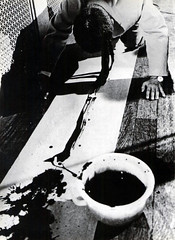
Allan Kaprow, an artist who in the 1950s pioneered an unrehearsed, nonverbal form of theater called a ”happening” that was intended to shatter the boundary between art and life, has died. He was 78.

Kaprow, who taught for years at the University of California-San Diego, died Wednesday at his home in Encinitas. He had been ill for some time and died of natural causes, said friend Tamara Bloomberg.

Kaprow’s happenings took place in real-life settings and involved unrelated or bizarre scenes acted out by willing participants. The audience was made up of people who happened to be there.

Born August 23, 1927, in Atlantic City, N.J., Kaprow called himself an ”un-artist.” He was primarily a painter and sculptor working with found objects.

R.I.P., Nam June Paik

UPDATE: For your listening pleasure, Hommage a John Cage (1958-1959). This four minute-plus track comes from the Works 1958.1979 that came out a couple years back on Sub Rosa (and is apparently now out-of-print). Not sure if any other plans are in the works to issue Paik’s musical output (Stephen Vitiello’s liner notes seem to indicate a lot of tapes), but I’d love to hear ’em.

The Associated Press and other media outlets are reporting that Nam June Paik has died:

Nam June Paik, the avant-garde artist credited with inventing video art in the 1960s by combining multiple TV screens with sculpture, music and live performers, has died. He was 74.

The Korean-born Paik, who also coined the term “Electronic Super Highway” years before the information superhighway was invented, died Sunday night of natural causes at his Miami apartment, according to his Web site.

In a 1974 report commissioned by the Rockefeller Foundation, Paik wrote of a telecommunications network of the future he called the “Electronic Super Highway,” predicting it “will become our springboard for new and surprising human endeavors.” Two decades later, when “information superhighway” had become the phrase of the moment, he commented, “Bill Clinton stole my idea.”

He also was often credited with coining the phrase, “The future is now.”

Trained in music, aesthetics and philosophy, he was a member of the 1960s art movement Fluxus, which was in part inspired by composer John Cage’s use of everyday sounds in his music. Another Fluxus adherent was the young Yoko Ono.

Paik made his artistic debut in Wiesbaden, West Germany, in 1963 with a solo art exhibition titled “Exposition of Music-Electronic Television.” He scattered 12 television sets throughout the exhibit space and used them to create unexpected effects in the images being received. Later exhibits included the use of magnets to manipulate or alter the image on TV sets and create patterns of light.

He moved to New York in 1964 and started working with classical cellist Charlotte Moorman to combine video, music and performance.

In “TV Cello” they stacked television sets that formed the shape of a cello. When she drew the bow across the television sets, there were images of her playing, video collages of other cellists and live images of the performance.

In one highly publicized incident, Moorman was arrested in 1967 in New York for going topless in performing Paik’s “Opera Sextronique.” Said one headline: “Cops Top a Topless `Happening.'” In a 1969 performance titled “TV Bra for Living Sculpture,” she wore a bra with tiny TV screens over her breasts.

Another of Paik’s pieces, “TV Buddha,” is a statue of a sitting Buddha facing its own image on a closed-circuit television screen, while “Positive Egg,” has a video camera aimed at a white egg on a black cloth. In a series of larger and larger monitors, the image is magnified until the actual egg becomes an abstract shape on the screen.

Paik also incorporated television sets into a series of robots. The early robots were constructed largely of bits and pieces of wire and metal; later ones were built from vintage radio and television sets.

Famous worldwide, Paik never forgot his native Korea. In 1986, public television showed Paik’s “Bye Bye Kipling,” a mix of taped and live events, mostly from Paik’s native Seoul; Tokyo; and New York. Two years later, Paik erected a media tower, called “The more the better,” from 1,003 monitors for the Olympic Games at Seoul.

Paik was left partially paralyzed by a stroke in 1996.

Funeral services will be held this week in New York, Hakuta told South Korea’s Yonhap news agency.

I went to the Guggenheim retrospective a few years ago, and it was pretty mind-bogglingly amazing. Especially the early, Fluxus-era stuff. Paik had been in pain for quite some time (as the AP obit says, he had a stroke a decade ago), so I hope he’s at peace now. R.I.P., Zen for Head.

Goodbye to Two Pioneers of Electronic Music

This week purveyed the unpleasant news of the demise of two ultra-important innovators of 20th Century music, Bob Moog and Luc Ferrari. I don’t think I have too much to add to the accolades and obituaries I’ve already read online and in print, but suffice to say I feel lucky to have been in the same room (though not at the same time) with these guys. Bob Moog visited Bard College, my alma mater, in 1996, and was as pleasant a guy as you could possibly imagine. It was amazing to me, though perhaps not surprising, that the guy who basically made synthesized music affordable to the masses was so accessible, so sweet and so helpful in spending time with students, answering their questions politely (even the dumb ones). Hearing from him first-hand about his teenage interest in the theremin was pretty amazing, to the point where I wished that I would’ve had half the adolescent curiousity, not to mention ingenuity. I never had the luck to chat with Luc Ferrari, but I did get to see a performance of his work — that he was present at — in Chicago in 2000 (I think), with a question-and-answer session as well. Though I have to admit there were a few moments that I wasn’t into, overall the music was fantastic, and so was the opportunity to see modern music performed in a nice, large space. Generally I’ve found Ferrari’s recorded works to be the most compelling of the stuff I’ve heard by the musique concrete “school” (though to be fair, I haven’t heard everything, obviously). And though Ferrari and Moog were in their 70s, they were still very active, so despite living long and fruitful lives, I consider it a pity that they’re gone.

GOODBYE, RAOUL DUKE

Aside from the pure anger and sadness i’m feeling about Hunter S. Thompson’s death, what gets to me is the manner. And I do not mean suicide per se, but the idea that all we as readers, as fans, etc. can do now is speculate. I certainly understand his son’s statement about respecting his family’s privacy, but at the same time it displays a naivete that bothers me — half of anything I’ve said to anyone else about this in the past 24 hours is speculation, which ultimately of course doesn’t matter. It doesn’t matter whether it was Dubya or mental illness or drugs or an accident or terminal illness or whatever that prompted HST to kill himself. What matters is yet another of our heroes is gone. We need to get used to it, but speaking for myself I find that a difficult concept to grasp. It’s hard to want to continue living when you know that everyone you ever looked up to is ready to shuffle off.

Speaking from a point that has little to do with his impact as a writer (though i think that cannot be overstated), and I hate to become a parody myself (too late!), but again, Louisville (blah blah). My hometown, the place that defined me as much as i defined it, was such a place of inspiration and exasperation. I knew that even before I read HST. And he was just an inspiration for getting out (though not to belittle those that stayed), much less changing the world in his way (so he didn’t crumble all the towers, but that’s a pretty tall order for anyone). HST, Muhammed Ali, Slint (ha!), anyway, yeah you get the drift.

Someday, some of HST’s Louisville contemporaries — friend and foe alike — will put together the true early portrait of the man (one of his best friends was the real estate mogul Paul Semonin) (one of his worst enemies was David Grubbs’s dad) (he was known even in high school for snaking gasoline for his motorcycle if you left your car in your driveway). I only know some bits and pieces. and I never met him, nor even got to see him speak, nor even got to see him just ramble drunkenly onstage, like at his last appearance in his hometown (Depp in tow). I just knew his writing, and an awful lot of it I knew before I even got to read it.

I have a short piece in the works here about how excited I was again for Louisville, for 2005 being a good rediscovery year. I’ll still post it, and it will still be exuberant, but I think now it will have to be tinged with some sort of sadness to reflect on HST’s passing.

RIP.

HUGH DAVIES, RIP

Well much like at the end of 2004, I have another bummer of a music-related death to report. British composer, performer, instrument inventor, lecturer and musicologist Hugh Davies has died. He was 62. I am most familiar with his sounds on the Music Improvisation Company LPs (one on Incus and one on ECM) and on the Work on What Has Been Spoiled LP with the mighty Borbetomagus. I never got a chance to hear his many other projects, though a number of them were recorded for posterity. This academic biography sums up his work nicely, and the GROB label also has an interesting sounding reissue of Warming Up with the Iceman from 2001.