Tag Archives: Obituary

Bernard Parmegiani, R.I.P.

We’ve gotten word via the internet that Bernard Parmegiani, one of our favorite composers, has passed today.


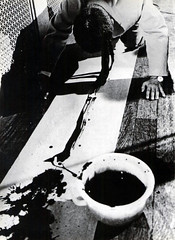
(Parmegiani on the left, with Christian Zanesi, from Wikipedia.)

We’ll post an official obituary as soon as we find one. In the meantime, enjoy Hors Phase from 1972:

Lou Reed, R.I.P.

Rolling Stone is reporting that Lou Reed has died today, at age 71:

Lou Reed, a massively influential songwriter and guitarist who helped shape nearly fifty years of rock music, died today. The cause of his death has not yet been released, but Reed underwent a liver transplant in May.

Needless to say, Reed’s adventures with the Velvet Underground, as well as his many solo outings after their dissolution, were very crucial to our musical development. Another anti-hero of the 1960s Lower East Side joins Jack Smith, Angus MacLise, Sterling Morrison, and many others on whatever Heaven’s version is of Ludlow Street. (Just kidding, we don’t believe in Heaven.)

Walter De Maria, R.I.P.

Reports across the internet indicate that Walter De Maria has died. He is one of my favorite sculptors and musicians of all time, his most famous works being the installations “Lightning Field” (in New Mexico), “The New York Earth Room,” and “The Broken Kilometer” (both in New York). He also briefly played drums in the Primitives, a precursor band to the Velvet Underground. Back in 2005, I wrote a review (for Swingset Magazine) of his self-released compact disc Drums and Nature, containing two pieces of his from the 1960s, in contrast with then-new works by Watersports:

Painting, sculpture, hell even being in a regular rock band wasn’t enough for Walter De Maria. After moving to New York in 1960, hobnobbin’ and theorizin’ and fluxus-izin’ with crazyman composer La Monte Young, playing drums for a stint in The Velvet Underground, and establishing himself as one of the prominent sculptors in the emerging “minimalist” scene, De Maria looked for – and found – the ever-larger gesture. In search of an art that was more than just “art,” De Maria in 1968 filled the Galerie Heiner Friedrich in Munich with dirt, kicking off the whole earthworks movement. That same year, he recorded “Ocean Music,” which along with “Cricket Music” (from 1964) is available for the first time on Drums and Nature. “Ocean Music,” recorded with the help of rediscovered minimalist badass Tony Conrad, is a meditative piece beginning with – you guessed it – the sound of waves crashing along some shore somewhere. Some heavy solo tribal drumming eventually mixes in, then subsumes the ocean sound, and what we’ve got is something akin to New Age if New Age wasn’t fucking lame. That is, a perfect representation of the “natural,” but with an acknowledgement of the “human” (incidentally, La Monte Young also recorded a vocal piece with the ocean off Long Island as his backin’ band around the same time for Columbia, but it has yet to see the light of day). “Cricket Music” is less meditative, but no less amazing (and no less truth-in-advertising, title-wise). Listening to these compositionally simple, yet striking pieces, it’s too bad that De Maria hasn’t seemed to have done much since, musically…

De Maria’s Drums and Nature will be available for download here for a limited time: http://www.sendspace.com/file/9vcr0i. If you miss it, you can also download it from UbuWeb here: http://www.ubu.com/sound/demaria.html.

UPDATE, 7/26/13: The Los Angeles Times has confirmed De Maria’s death by publishing an obituary here: http://www.latimes.com/entertainment/arts/culture/la-et-cm-walter-de-maria-died-20130725,0,1642854.story.

UPDATE, 7/27/13: The New York Times has published their obituary of Walter De Maria here: http://www.nytimes.com/2013/07/27/arts/design/walter-de-maria-artist-on-grand-scale-dies-at-77.html.

John Tchicai, R.I.P.

We’re seeing some unfortunate news today on the internet that Danish saxophonist John Tchicai has died, though so far without any official confirmation. This is terrible news, if true, as Tchicai has been long known as one of the best players, yet he was sort of weirdly unheralded outside the jazz cognoscenti. His discography is long and broad, going back to early 1960s work with Archie Shepp, the New York Art Quartet (with Roswell Rudd, Milford Graves, Lewis Worrell, and Amiri Baraka), and John Coltrane‘s classic Ascension. It should also be said that he continued to play and compose some really great stuff over the past few decades, though the last time we saw him play was in Chicago in the late 1990s. He will be greatly missed.

We’ll update when we find official (or otherwise) obituaries and tributes posted, and hopefully we’ll post some of Tchicai’s music to sample, as well.

UPDATE, 10/7/2012, 9:30 PM: One good place to start in Tchicai’s massive discography is the self-titled debut from 1964 by the New York Art Quartet, his classic group with Roswell Rudd, Milford Graves, and Lewis Worrell (and Amiri Baraka, reciting poetry on the track “Black Dada Nihilismus”). So, for a short time, you can find it here: http://www.sendspace.com/file/5cawmw.

UPDATE, 10/8/12: The Associated Press has published an obituary for Tchicai, which has been picked up by several news outlets: http://www.google.com/hostednews/ap/article/ALeqM5gR2SgcqNtQQiD9zYUc7-67LDCYKA?docId=a95085a0576e4f50936c160ba2ff22bf.

R.I.P. Byard Lancaster and Tom Bruno

Inexplicably, the music world lost two great jazz musicians yesterday. Byard Lancaster, a multi-reedist — who would be revered if the only cool thing he did was appear on Sunny Murray‘s self-titled ESP-Disk album, but managed to also lead and collaborate on some great titles including his own It’s Not Up to Us — died of pancreatic cancer at the age of 70.

Additionally, Tom Bruno, a drummer best known for his work in the quartet Test with Matthew Heyner, Sabir Mateen, and Daniel Carter, died yesterday.


(Photograph of Test by Michael Galinsky — from left to right: Daniel Carter, Tom Bruno, Matthew Heyner, Sabir Mateen.)

They will both be missed.

R.I.P. İlhan Mimaroğlu

One of our favorite composers, İlhan Mimaroğlu, died yesterday at the age of 86. His Wikipedia page offers a short biography:

He was born in Istanbul, Turkey, the son of the famous architect Mimar Kemaleddin Bey depicted on the Turkish lira banknotes, denomination 20 lira, of the 2009 E-9 emission. He graduated from Galatasaray High School in 1945 and the Ankara Law School in 1949. He went to study in New York supported by a Rockefeller Scholarship. He studied musicology at Columbia University under Paul Henry Lang and composition under Douglas Moore.

During the 1960s he studied in the Columbia-Princeton Electronic Center under Vladimir Ussachevsky and on occasions worked with Edgard Varèse and Stefan Wolpe. He is an electronic music composer, and also was the producer for Charles MingusChanges One and Changes Two, as well as Federico Fellini‘s Satyricon. He was awarded the Guggenheim Fellowship in music composition in 1971.

He worked as a producer for Atlantic Records, and created his own record label there, Finnadar Records,and collaborated with trumpeter Freddie Hubbard on a moving anti-war statement, Sing Me a Song of Songmy in the same year.

His notable students included Ingram Marshall.

In tribute to him, we’re making a few of his albums available for download.


İlhan Mimaroğlu & Freddie Hubbard, Sing Me a Song of Songmy, a Fantasy for Electromagnetic Tape (Atlantic, 1971)


Outstanding Warrants
(Southport, 2001)

Missing Pieces (Earlabs, 2003)

Mike Kelley, R.I.P.

The artist and musician Mike Kelley has died, apparently by his own hand (from Blouin Artinfo):

Artist Mike Kelley has passed away at his home in Los Angeles, having apparently taken his own life. The tragic news was confirmed to BLOUIN ARTINFO by Helene Winer, of New York’s Metro Pictures gallery, a long-time associate of the artist.

“It is totally shocking that someone would decide to do this, someone who has success and renown and options,” said Winer. “It’s extremely sad.” She added that the artist had been depressed.

Kelley was born in 1954 in a suburb of Detroit, Michigan. He became involved in the city’s music scene as a teen, and while a student at the University of Michigan, formed the influential proto-punk band Destroy All Monsters with fellow artists Jim Shaw, Niagara, and Cary Loren (a retrospective devoted to Destroy All Monsters was held at L.A.’s Prism gallery last year). Together, the band hatched a style of performance that skirted the edge of performance art.

After graduating college in 1976, he moved to Los Angeles to attend the California Institute of the Arts, studying alongside teachers like John Baldessari and Laurie Anderson. Music continued to be a constant passion: he formed another band, “Poetics,” with fellow CalArts students John Miller and Tony Oursler.

Kelley’s career took off in the early 1990s, with solo shows at the Whitney, LACMA, and other international venues. He and Oursler organized a well-recived installation — a kind of monument to punk — at Documenta X in 1997. In the early 2000s, he began exhibiting with Gagosian Gallery after 20 years with Metro Pictures.

For his 2005 exhibition “Day is Done,” Kelley filled Gagosian with found yearbook photos, video footage, and automated furniture, prompting New York Magazine critic Jerry Saltz to describe the show as an example of “clusterfuck aesthetics.” More conventionally, he was associated with the notion of “abject art,” highlighting the irrational and the repulsive.

Kelley’s work will be included in the upcoming Whitney Biennial. It is the eighth time his work has been included in the biannual exhibition.

Perhaps best known in the music world for his cover of Sonic Youth’s Dirty album, Kelley was also a founding member of Destroy All Monsters and Poetics, and worked with many musicians over the course of his career.

R.I.P. Syd Barrett

Oh man. Fuck. Syd Barrett, founder of Pink Floyd, has passed at 60.

From the Associated Press:

Syd Barrett, the troubled genius who co-founded Pink Floyd but spent his last years in reclusive anonymity, has died, a spokeswoman for the band said Tuesday. He was 60.

The spokeswoman — who declined to give her name until the band made an official announcement — confirmed media reports that he had died. She said Barrett died several days ago, but she did not disclose the cause of death.

Barrett co-founded Pink Floyd with fellow Cambridge student Roger Waters in 1965 and wrote many of the band’s early songs.

He got the name of the band from two old blues musicians, Pink Anderson and Floyd Council. Pink Floyd’s jazz-infused rock made them darlings of the London psychedelic scene. It was the first British group to do light shows in concert and its music and style was weird even for that era.

The 1967 album “The Piper at the Gates of Dawn” — largely written by Barrett — was a commercial and critical hit. The group, with additional band members Nick Mason and Richard Wright, came to be known as England’s premier acid rockers.

But the band did a turn for the worse when Barrett became mentally unstable from the pressures of drugs and fame and had to leave the band in 1968 — five years before Pink Floyd’s most popular album, “Dark Side of the Moon.”

Barrett spent much of the rest of his life living quietly in his hometown of Cambridge.

Guitarist David Gilmour, another Cambridge student, took Barrett’s place.

A small, private funeral would be held, the spokeswoman said.

R.I.P., Allan Kaprow


From the Monterey County Herald:

Allan Kaprow, an artist who in the 1950s pioneered an unrehearsed, nonverbal form of theater called a ”happening” that was intended to shatter the boundary between art and life, has died. He was 78.

Kaprow, who taught for years at the University of California-San Diego, died Wednesday at his home in Encinitas. He had been ill for some time and died of natural causes, said friend Tamara Bloomberg.

Kaprow’s happenings took place in real-life settings and involved unrelated or bizarre scenes acted out by willing participants. The audience was made up of people who happened to be there.

Born August 23, 1927, in Atlantic City, N.J., Kaprow called himself an ”un-artist.” He was primarily a painter and sculptor working with found objects.

R.I.P., Nam June Paik

UPDATE: For your listening pleasure, Hommage a John Cage (1958-1959). This four minute-plus track comes from the Works 1958.1979 that came out a couple years back on Sub Rosa (and is apparently now out-of-print). Not sure if any other plans are in the works to issue Paik’s musical output (Stephen Vitiello’s liner notes seem to indicate a lot of tapes), but I’d love to hear ’em.

The Associated Press and other media outlets are reporting that Nam June Paik has died:

Nam June Paik, the avant-garde artist credited with inventing video art in the 1960s by combining multiple TV screens with sculpture, music and live performers, has died. He was 74.

The Korean-born Paik, who also coined the term “Electronic Super Highway” years before the information superhighway was invented, died Sunday night of natural causes at his Miami apartment, according to his Web site.

In a 1974 report commissioned by the Rockefeller Foundation, Paik wrote of a telecommunications network of the future he called the “Electronic Super Highway,” predicting it “will become our springboard for new and surprising human endeavors.” Two decades later, when “information superhighway” had become the phrase of the moment, he commented, “Bill Clinton stole my idea.”

He also was often credited with coining the phrase, “The future is now.”

Trained in music, aesthetics and philosophy, he was a member of the 1960s art movement Fluxus, which was in part inspired by composer John Cage’s use of everyday sounds in his music. Another Fluxus adherent was the young Yoko Ono.

Paik made his artistic debut in Wiesbaden, West Germany, in 1963 with a solo art exhibition titled “Exposition of Music-Electronic Television.” He scattered 12 television sets throughout the exhibit space and used them to create unexpected effects in the images being received. Later exhibits included the use of magnets to manipulate or alter the image on TV sets and create patterns of light.

He moved to New York in 1964 and started working with classical cellist Charlotte Moorman to combine video, music and performance.

In “TV Cello” they stacked television sets that formed the shape of a cello. When she drew the bow across the television sets, there were images of her playing, video collages of other cellists and live images of the performance.

In one highly publicized incident, Moorman was arrested in 1967 in New York for going topless in performing Paik’s “Opera Sextronique.” Said one headline: “Cops Top a Topless `Happening.'” In a 1969 performance titled “TV Bra for Living Sculpture,” she wore a bra with tiny TV screens over her breasts.

Another of Paik’s pieces, “TV Buddha,” is a statue of a sitting Buddha facing its own image on a closed-circuit television screen, while “Positive Egg,” has a video camera aimed at a white egg on a black cloth. In a series of larger and larger monitors, the image is magnified until the actual egg becomes an abstract shape on the screen.

Paik also incorporated television sets into a series of robots. The early robots were constructed largely of bits and pieces of wire and metal; later ones were built from vintage radio and television sets.

Famous worldwide, Paik never forgot his native Korea. In 1986, public television showed Paik’s “Bye Bye Kipling,” a mix of taped and live events, mostly from Paik’s native Seoul; Tokyo; and New York. Two years later, Paik erected a media tower, called “The more the better,” from 1,003 monitors for the Olympic Games at Seoul.

Paik was left partially paralyzed by a stroke in 1996.

Funeral services will be held this week in New York, Hakuta told South Korea’s Yonhap news agency.

I went to the Guggenheim retrospective a few years ago, and it was pretty mind-bogglingly amazing. Especially the early, Fluxus-era stuff. Paik had been in pain for quite some time (as the AP obit says, he had a stroke a decade ago), so I hope he’s at peace now. R.I.P., Zen for Head.